What It Costs
We're not going to hand you a number here that doesn't hold up once we're standing in your garage. What drives the bill isn't the zip code, it's what's actually on the door - and in Searcy, that usually means original hardware from a house built somewhere between 1975 and 1997, with the median landing around 1982. A torsion spring on a door that age is often a size builders stopped installing decades ago, and matching it costs more in parts search time than the labor itself. Openers from that era, if they're still the original unit, are usually chain-drive with worn gears rather than anything with a circuit board worth troubleshooting.
The honest limitation: if your opener or spring assembly is a discontinued builder-grade unit, we may need a day or two to source the right part rather than fix it same-visit. That's not us stalling - it's the reality of hardware this old.
With median household income in the area at $43,811, a lot of the calls we get are people trying to decide whether a repair is worth it versus letting the whole door go. That's a fair question, and it depends on the door, not on a flat number we could quote you before we've seen it.
When Waiting Is Fine
Not every noisy or stiff door is an emergency, and we'd rather tell you that than run a truck out for nothing. If your door still opens and closes on its own power, just louder or slower than it used to, that's usually wear on rollers or hinges - original parts on a house from the 1980s or 90s stock that makes up most of this area are due for replacement, not panic.
Where waiting is not fine: a torsion spring that's visibly gapped or a cable that's frayed. Those don't get better with time, and a spring under tension that finally lets go can take a knuckle with it. Same goes for a door that's come off track - leave that alone until someone who knows the hardware looks at it.
For everything else - a slow close, a chirp on the rollers, an opener that hesitates before it catches - you can run it a few more weeks. Springs and openers on houses from this era were built to a certain standard, and knowing which failure is cosmetic versus structural is most of the judgment call in this trade.
The Problem
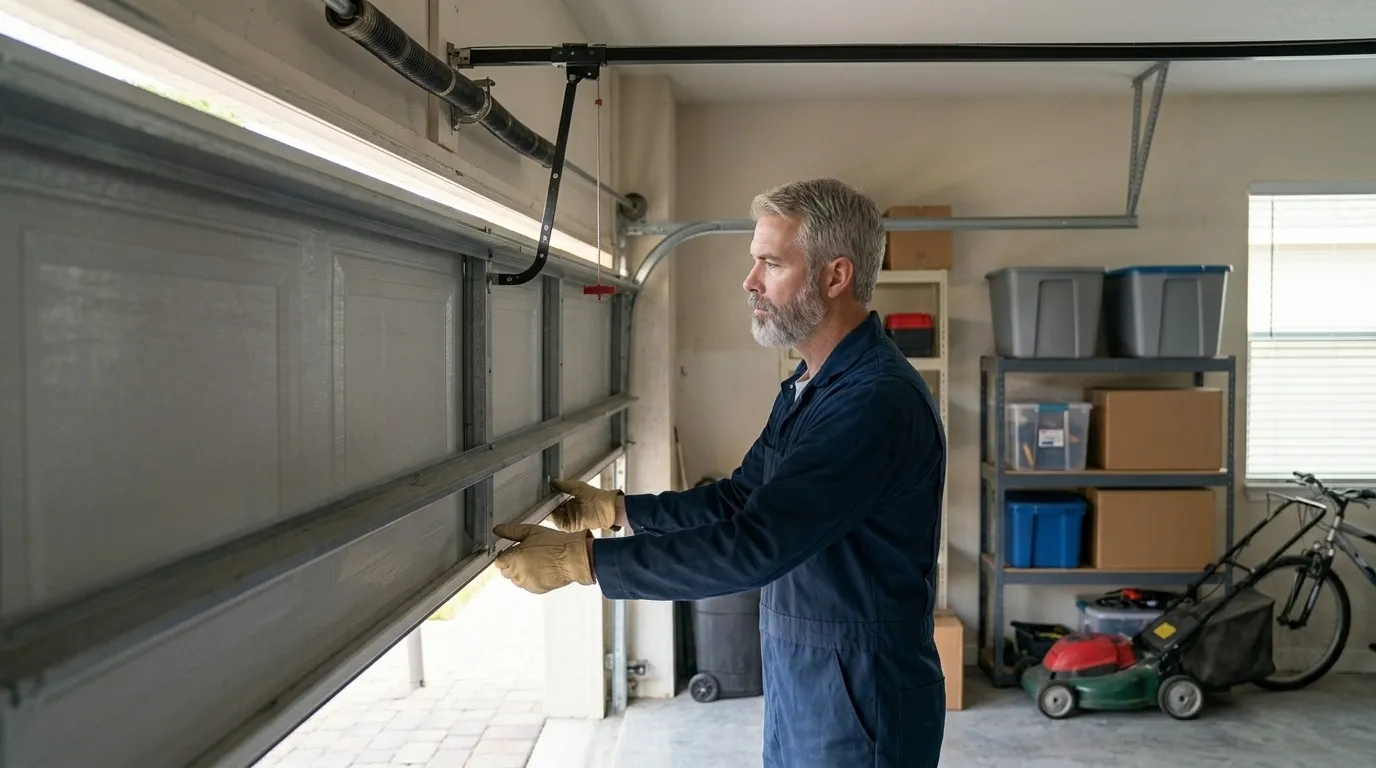
The core issue we run into across this area is age matching. With roughly 2,979 owner-occupied houses out of 6,049 households built mostly in that 1980s-90s window, the garage doors on them are original or close to it - one-piece or sectional steel doors on side-mounted torsion hardware that predates the parts most suppliers stock today.
That creates a specific pattern: the door itself is often fine structurally, but the spring, the cable drum, or the opener gear is a size or style that's been superseded twice over. Replacing like-for-like isn't always possible, which means some jobs turn into a partial upgrade - new spring hardware on an old door, or a new opener mounted to an old track - rather than a clean swap.
We see this whether the house is in town or out toward McRae or Bald Knob, ten miles either direction - the build era carries more than the address does. It's worth knowing going in that a repair on a door this old sometimes costs close to what a new door would, and at that point replacing beats patching.